
Written by Ella Gibbs and translated by Stevie Thomas
Scroll for Welsh
As a person particularly in touch with my Welsh heritage, I am just as excited as the next Welsh individual for having made it to World Cup. Despite my lack of interest in football, I have found myself dedicated to watching the matches and finding myself turning up the radio and belting out ‘Yma o hyd’ to BBC Wales for the seventh time in a day and leaving it comfortably on repeat in my brain for the rest of the day.
Procrastination scrolling from my assignment, I came across a video of Dafydd Iwan telling facts about his patriotic song, one of which was that the original manuscript of the song lies in the Aberystwyth National Library.
As a student of Aberystwyth for over a year now studying a degree in English literature, and who has still not attended the biggest library in Wales, this was the perfect excuse.
Equipped with my Cymru bucket hat that I acquired for £7.99 from the current CK’s promotional offers, I headed for the library on a quest for the manuscript of the recently topical song.
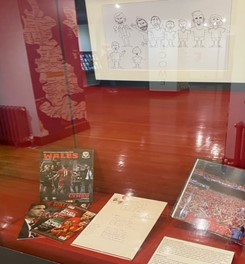
Entering the Library, I found the song particularly easy to find. The entrance leads into the shop and past the ‘Yma o Hyd’ themed gifts into an open hall where there is a world cup exhibition where the original song lyrics are on a piece of paper behind glass.
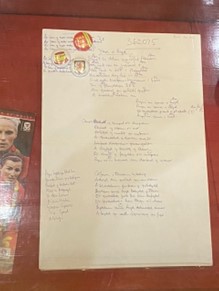
It was surreal to see the lyrics, jotted on a piece of paper like any ordinary unexceptional notes, because it is an exceptional song. It served as a reminder that success can come from any form. The song translating to ‘we are still here’ is a protest song, a reminder that Wales is still here, and it has plenty to offer, from its poets and writers, artists, music, sporting achievements and beauty spots. The song is surrounded in the room, by various football memorabilia and videos from old world cups.
As I continue to write this now, both Wales and England are out of the world cup running’s, but it is still evident that it meant a lot to its fans. Seeing the Welsh team and fans singing Hen Wlad Fy Nhadau (The Welsh National anthem) in Qatar, singing far more passionately than any other sporting team sing theirs is a proud moment.
The unique asset the Welsh fans have evidenced throughout this tournament is that they are happy, supportive fans, they boys have been backed by the most remote people in Wales and also those who don’t like football, like me. The Welsh fans are just happy to be there. Although we may have not won, we still showed the world that Wales is still here.
Yma o Hyd
Fel person sydd a chysylltiad arbennig a fy nhreftadaeth Gymreig, rydw I’n un mor gyffroes a’r unigol Cymreig nesaf I wedi cyrraedd Cwpan y Byd. Er gwaethaf fy niffyg diddordeb ym mhel-droed, rwyf wedi ffeindio fy hyn yn ymroddedig I wylio’r gemau ac yn troi’r radio I fyny ac yn canu allan ‘Yma o Hyd’ I BBC Cymru am y seithfed tro mewn dydd ac yn ei chadw yn gyfforddus yn ailadrodd yn fy ymennydd am gweddyll y dydd.
Yn sgrolio I oedi gwneud fy aseiniad, roeddwn I’n dod ar draws fideo o Dafydd Iwan yn dweudd ffeithiau am ei chan gwladgarol, un oedd bod yr llawysgrif gwreiddiol yn gorwedd mewn Llyfrgell Genedlaethol Aberystwyth.
Fel myfyrwyr o Abeystwyth am dros blwyddyn nawr yn astudio gradd mewn llenyddiaeth Saesneg, a pwy sydd dal heb mynychu’r llyfrgell mwyaf yng Nghymru, hyn oedd yr esgus perffaith.
Yn gwisgo fy het bwced Cymru a wnes I gaffael am £7.99 o’r cynygion hyrwyddo cyffredol CK’s, es I I’r llyfrgell ar gwest am y llawysgrif o’r can gyfoes yn ddiweddar.
Yn mynd I mewn I’r lyfrgell, roedd hi’n arbennig o hawdd dod o hyd I’r can. Mae’r mynedfa yn arwain I mewn I siop a hebio’r anrhegion thema ‘Yma o Hyd’ I mewn I neuadd lle mae arddangosfa Cwpan y Byd lle mae’r geiriau gwreiddiol I’r can ar ddarn o bapur tu-ol gwydr.
Roedd e’n swreal I weld y geiriau wedi ei nodi ar darn o bapur fel unrhyw nodiadau arferol aneithriadol, achos can eithriadol yw hi. Fe’I gwasaneithir fel atgof fod gall llwyddiant dod o unrhyw ffurf. Mae’r geiriau sy’n dweud ‘Ry’n ni yma o hyd’ yn brotest, atgofiad fod Cymru dal yma, ac yn cael digon I gynnig, o’u beirdd ac ysgrifenwyr, artistiaid, cerddoniaeth, cyflawniadau chwaraeon a mannau prydferth.Mae’r can wedi ei amgylchynu yn yr ystafell, efo memrobilia pel-droed amrywiol a fideos o gwpanau’r Byd hen.
Yn nodiadol, mae yna hefyd wal o negeseuon o lwc dda mewn cymysgedd o Gymraeg a Saesneg, yn dymuno’r bechgyn pob lwc yn y Cwpan y Byd. Mae’n amlwg fod y Cwpan y Byd yn dod a phobl Cymreig efo’u gilydd, mewn ffordd fel erioed o’r blaen, efo’r wlad yn cefnogi’r bechgyn.
Wrth I mi ysgrifennu hon nawr, mae Cymru a Lloegr allan o’r Cwpan y Byd, ond mae’n amlwg ei fod yn golygu llawer I’w gefnogwyr. Yn gweld yr tim Cymreig yn canu Hen Wlad Fy Nhadau (anthem cenedlaethol Cymru) yn Catar, yn canu llawer mwy angerddol na unrhyw tim chwaraeon yn canu’u anthem nhw yn moment balch.
Mae’r ased unigryw sydd gan cefnogwyr Cymru sydd wedi cael ei brofi trwy gydol y twrnament hon yw eu fod nhw’n cefnogwyr hapus ac yn gefnogol, mar’r bechgyn wedi cael eu gefnogi gan y bobl mwyaf anghysbell ynh Nghymru a’r rhai hynny sydd ddim yn hoffi pel-droed, fel fi. Mae’r cefnogwyr Cymru ond yn hapus I fod yna. Er nid oedden ni’n ennill, redden ni dal yn dangos y Byd fod ni yma o hyd.